
Construction Timelapse in Malaysia
A Practical Overview for Project Owners and Consultants
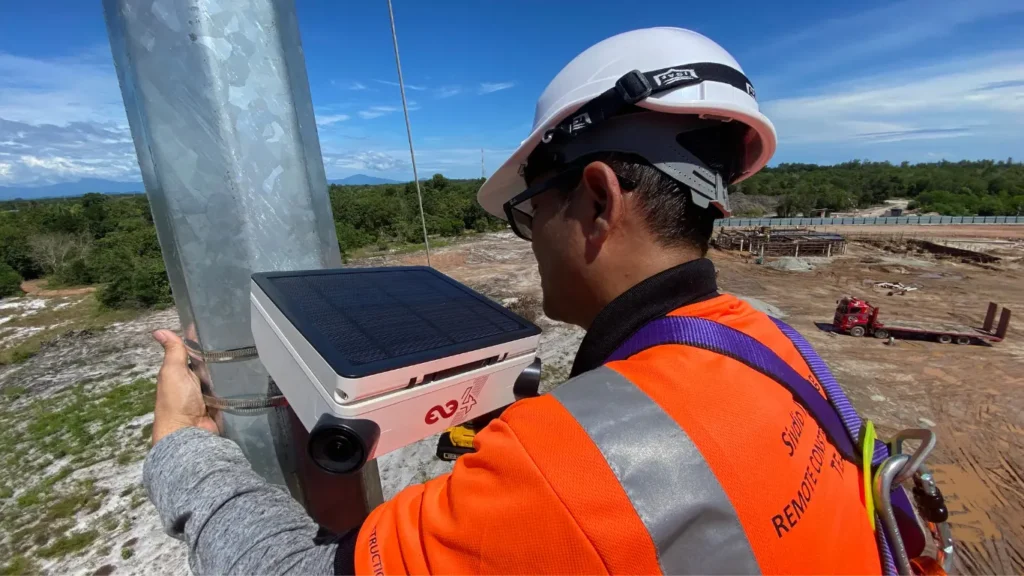
This Insight addresses a fundamental but frequently misunderstood question faced by project owners, consultants, engineers, and institutional stakeholders in Malaysia:
What exactly is construction timelapse, and how is it formally used on serious projects?
This is not a promotional overview. It is written to clarify function, governance, and practical application—without vendor bias, exaggeration, or sales positioning.
What “Construction Timelapse” Actually Means in the Malaysian Context
In Malaysia, construction timelapse is not defined by the video output. It is defined by the method of systematic visual data capture across the lifecycle of a project.
At a professional level, construction timelapse consists of:
Fixed-position cameras installed at predetermined vantage points
Automated image capture at consistent intervals (e.g. every 5–15 minutes during working hours)
Long-term operation across months or years
Controlled image retention, retrieval, and sequencing
The timelapse video is a derived artefact.
The primary asset is the chronological visual record.
On serious projects, this record is treated as factual reference material, not as promotional media.
How Construction Timelapse Is Formally Used on Serious Projects
Progress Verification (Not Progress Reporting)
Timelapse provides objective confirmation of:
Actual commencement of work
Periods of inactivity or disruption
Physical sequencing of activities
Reports interpret progress.
Timelapse anchors it.
This distinction becomes critical when programme narratives diverge.
Claims, Delays, and Context Establishment
In delay events or extension-of-time assessments, timelapse is commonly used to:
Corroborate access constraints
Validate concurrent delay arguments
Establish weather or force majeure impact
Confirm third-party interference
It does not determine outcomes.
It reduces ambiguity.
Compliance and Institutional Oversight
For projects involving GLCs, statutory bodies, or regulated infrastructure, timelapse functions as:
A passive audit trail
A non-intrusive monitoring layer
A historical compliance reference
This aligns with Malaysia’s increasing emphasis on documentation discipline under bodies such as CIDB Malaysia.
Engineering Review and Learning
Project teams use timelapse retrospectively to:
Analyse sequencing efficiency
Identify coordination breakdowns
Compare method statements against actual execution
This function is rarely advertised, but it is one of the most enduring benefits.
What Construction Timelapse Is Not
To avoid misinterpretation, it is important to be explicit.
Construction timelapse is not:
CCTV surveillance
Security monitoring
Live site supervision
A substitute for clerk-of-works
A marketing video service
Projects that conflate these roles usually underperform in all of them.
Typical Deployment Models in Malaysia
Project-Level Timelapse
1–3 cameras
Single structure or zone
Documentation-focused
Common on high-rise, industrial, and short-to-mid duration projects.
Portfolio-Level Timelapse
Standardised configuration
Centralised access
Cross-project comparability
Used by developers and repeat-build owners.
Long-Horizon Infrastructure Monitoring
Multi-year operation
Stability and data continuity prioritised
Often integrated with other monitoring systems
This is where lightweight providers most commonly fail.
Data Integrity Matters More Than Image Quality
A common misconception is that higher resolution equals higher value.
On serious projects, priority is given to:
Capture consistency
Timestamp accuracy
Camera stability
Data continuity
Secure retention
A technically imperfect image captured reliably for 24 months is more valuable than a cinematic image that fails intermittently.
Procurement Reality: How Timelapse Is Actually Specified
In Malaysia, construction timelapse is typically procured through:
Provisional sums
Specialist subcontract scopes
Owner-appointed monitoring packages
Independent documentation line items
It is rarely awarded to:
Pure media agencies
Short-term freelancers
Vendors without construction experience
This is not about prestige; it is about risk containment.
Why Many Timelapse Outputs Fail to Age Well
A useful test is simple:
Would this still be defensible if reviewed three years later?
Weak timelapse systems often fail because:
Cameras were relocated mid-project without records
Capture intervals were changed inconsistently
Data gaps were not logged
Outputs were edited without traceability
Professional systems preserve context, not just visuals.
Summary for Decision-Makers
Construction timelapse in Malaysia should be understood as:
A documentation discipline, not a video product
A risk-reduction tool, not a marketing expense
A longitudinal record, not a highlight reel
When treated accordingly, it integrates naturally into serious projects without narrative friction.
Closing Note
This Insight intentionally avoids vendor names, platforms, or product claims.
Serious stakeholders evaluate systems by operational behaviour, not branding.
Subsequent Insight posts will examine specification pitfalls, governance models, data ownership, and why many enhanced claims fail under scrutiny—using the same evidentiary standard applied here.
Nadia Khalid, Sales Representative,
sales [at] timelapsemalaysia.com